




To watch videos, chat with others, send and receive emails, shop, conduct business, and explore websites, we are reliant on the Internet. More than 40 zettabytes (or one trillion gigabytes) of digital data were reportedly consumed last year, primarily through web searches. Did you realize that a Google data center stores your browser history and sends the search results in a millisecond? These digital media are maintained, transmitted, and stored in data centers. Over 7500 data centers exist worldwide, and that number is rising.
Data centers exist in a variety of shapes, sizes, and configurations to suit the particular data processing requirements for which they were designed. Private cloud, public cloud, private company, and government are the four different types of data centers. One server in a room to enormous dedicated buildings housing hundreds of servers are all examples of data centers.
Data Center Cabling Types
Switches, routers, servers, security tools, and storage systems are found in data centers and are required to store and transfer massive volumes of data, typically to a computer or telecommunications network system. To other devices in the network infrastructure, all data center devices must be able to send data swiftly and reliably. In order for data and signals to go between these devices, cables are used to connect them.
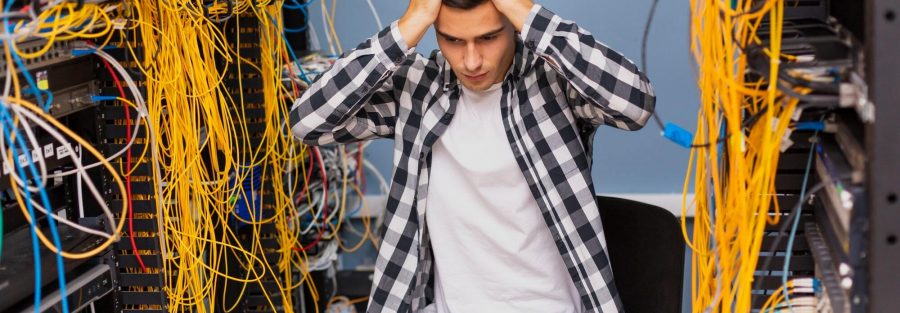
There may be miles of cable in large data centers. Connection problems are more likely to occur as there are more wires present. A structured cabling system that arranges the cables is frequently used in larger data centers. Structured cabling systems can resemble cable trays that are hanging from the ceiling or affixed to the top of racks. Additionally, there are floor trays. Small, private data centers can function with an unstructured cabling system’s disarray.
There are several cable types in addition to the two cabling systems. Twisted pair, coaxial, and fiber-optic cables make up this group. The data flow is impacted by the type of cable used. Fiber-optic connections are the best choice for most data centers
Cable connectivity problems in data centers
The global media consumption and need for data centers will grow as the Internet becomes more and more integrated into our daily lives. However, if a data center goes down, the ease of the Internet is lost.
Data centers need cables in order to operate properly. The top five data center cable connectivity concerns that could occur during a data center upgrade or construction are as follows:
- Using an Improper Module or Interface
Hyperscale, Colocation, Wholesale Colocation, Enterprise, and Telecom are the five categories for data centers. Each of these data center network topologies was created with a specific medium for processing and transmitting data in mind (i.e. Cloud storage, Software as a Service, IT, security, and telecommunications). Since each data center design has a distinct purpose, they all need a specific minimum amount of power and bandwidth to process data. The interface type must fit the network design for the data center cabling to function at its best.
- Using the Wrong Fiber-Optic Cables
Inappropriate fiber-optic cable use can slow down data transfer and interfere with media connectivity. The proper cables guarantee that data center equipment is linked correctly. Different fiber-optic cables will suit different connections, thus they are not all the same. There are single-mode and multi-mode cables. Both of the two may be utilized simultaneously. For assistance choosing one for your business, speak with the experts at Rapidnet.
- Misguided Polarity
The arrangement of fibers inside a cable is known as polarity. The direction at which data is transferred through the wires is determined by this fiber configuration. Cables have pinned and unpinned connectors that control the data flow, similar to the positive and negative ends of batteries. The fiber-optic cables must be matched before being attached to a connector (a pinned end connected to the non-pinned side of the other cable). Type A (straight-through) and Type B (inverted) polarity are used in data centers. This indicates that a cable with a fiber at position one will reach location one on the opposite end and position twelve (the inverted type). The polarity will be obstructed by improper cable installation.A data center will become useless if data is transmitted in the wrong way.
- Wrong Connectors
As discussed before, the pinned end of one fiber-optic cable must fit into the non-pinned end of an adjacent cable for proper polarity. Whether Type A or Type B polarity is used, the cables must be suitable for that particular type. Even if the cables are suitably sized for one another, data transmission can still be unsuccessful if the polarity types are different.
- Dirty Conditions and Improper Installation
The wires may become dirty if they are installed in an environment with a lot of dust and dirt. When fiber-optic cables are not cleaned before installation, they won’t function properly since the fibers are sensitive to dust particles. Even brand-new, sealed wires need to be cleaned before installation. Inadequate installation can also result in cable fractures and microbends, which will impair the cables’ capacity to send data to devices across the data center network.
The tiniest cabling error can result in major, expensive problems for your business, government or public entity, school, or airport, regardless of whether the goal of your data center project is to provide security, a wireless network, audio visual, or distributed antenna systems. The experts at Rapidnet are familiar with the challenges of data center networking. In order to ensure the success of your data center project, our qualified personnel take these concerns into account when installing your cabling. Make an appointment with us right now.


2 Comments
Riva Collins
It’s no secret that the digital industry is booming. From exciting startups to need ghor
global and brands, companies are reaching out.
Obila Doe
It’s no secret that the digital industry is booming. From exciting startups to need ghor hmiu
global and brands, companies are reaching out.